How to design a façade using 8 steps?

This post idea came to me while I was teaching this first-year architecture course called Principles of Design. If you´ve ever studied design or architecture theory, you should be familiar with these principles: point, line, form, volume, rhythm, symmetry, contrast, hierarchy, harmony, gradation, radiation, anomaly, repetition, and so on.
Interestingly, the course program barely mentions them. Instead, it focuses on broader concepts, such as: What is architectural theory? What is an architectural concept? What is an analogy in design? and What environmental conditions influences the design? These are known as design variables. The first challenge in teaching architectural theory is that students need to apply what they learn in practice, otherwise, they will forget it. Therefore, so I came up with this design exercise, which incorporates all the subjects taught in the course.
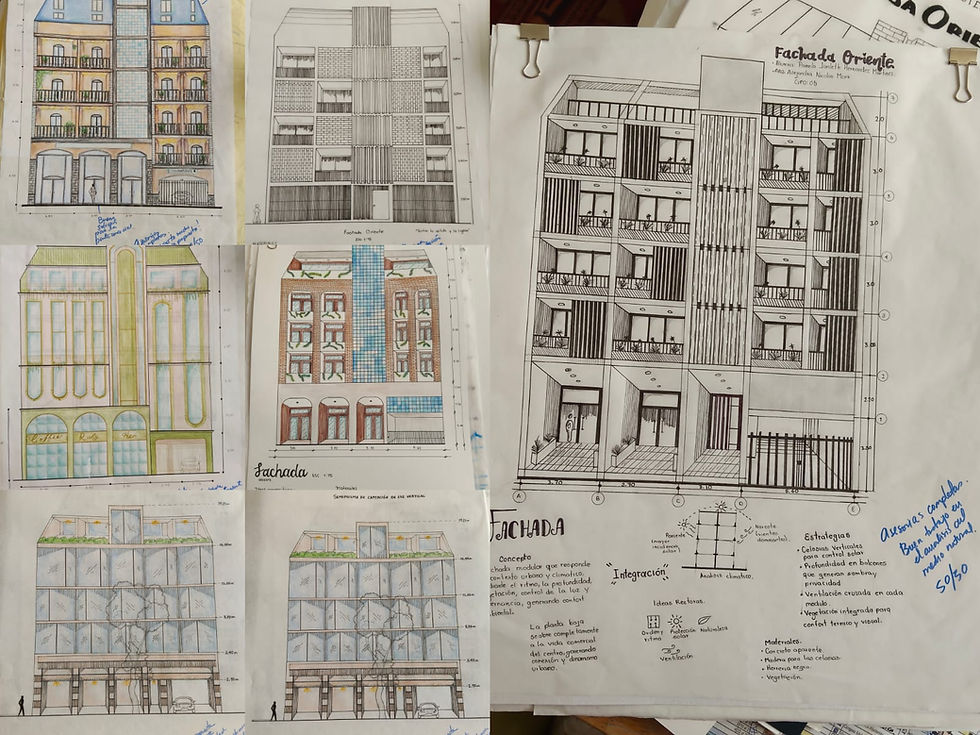
So, the main goal of this exercise was to design a façade that responded to the environmental conditions, such as weather, bio-climatic criteria, material logic and principles of design. The rule was that it had to be made by hand, pencils, ink, markers, rulers and set squares.
After sketching, the student had to visit the site and analyse its solar orientation, temperature, rainfall, winds, and urban infrastructure.
During this step, students had to define their architectural concept. In architecture, a concept is the guiding idea behind a design, you should be able to explain it in a short clear phrase. One thing I remind my students is that if you remove the concept from your design and nothing changes, then you did not have a concept in the first place.
First idea, this must include your compositional idea, using the principles of design -Use the book of Wucius Wong o D.K. Ching- also explain your intentions regarding the construction materials and how they will respond to the weather conditions.
Second idea (This stage involves making corrections based on the first review). Correct whatever your teacher observed, improve your use of the principles of design -rhythm, contrast or whichever principles you have chosen- and refine your solutions to the weather conditions.
This is the synthesis for the third and fourth step. At this stage, your facade must demonstrate a conceptual, material, and environmental coherence. Ask yourself: Can this façade actually be built?
Next, review your material palette, ask yourself: Are the material appropriate for the weather conditions? Are they easy to maintain? Can we build the structure to support them? What is the environmental cost of using them?
At this stage, consider if the design principles are visible in your façade. Is there an intentional use of rhythm, gradation, contrast, texture, symmetry, color, etc?
The last step is the final representation. How you will present your design process? Remember to show a clear drawing, write down your architectural concept, also present your material palette and your environmental strategy.
I truly hope that, if you are an architectural theory professor, this design exercise can be helpful for a class or two, especially if yours students need to apply theory through a practical exercise.


Interesting how this exercise was executed since we as students have been sort of indoctrinated on how to perform our creativity through architectural design and when we find ourselves with a different approach from our teachers on how to execute a certain exercise it becomes challenging but enrichment.